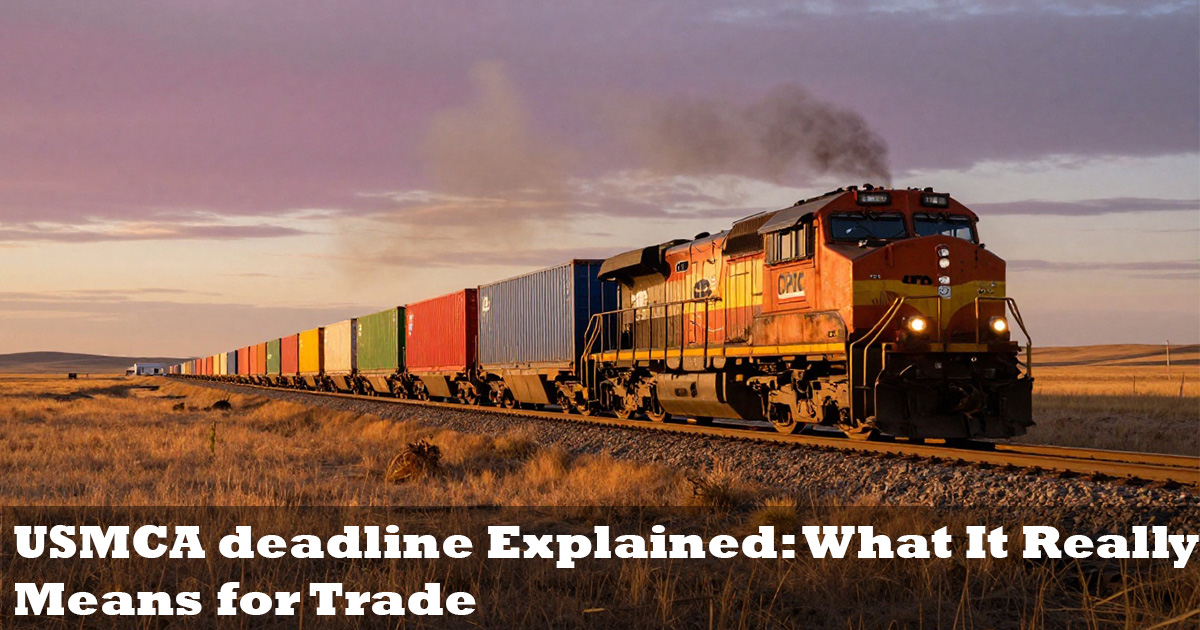
The USMCA deadline has become one of the most talked-about moments in North American trade discussions, especially for businesses and policymakers across the United States, Canada, and Mexico.
At first glance, the phrase sounds urgent—almost like a ticking clock for a major trade collapse. But in reality, the USMCA deadline is not a sudden cutoff point. It is part of a structured review system built into the agreement that replaced NAFTA.
This system affects industries worth trillions in cross-border trade, from automobiles to agriculture. Yet despite the noise, the agreement is designed to continue functioning while discussions unfold.
In this article, we break down the USMCA deadline in a simple, human way so you can understand what is actually happening—and what is not.
What the USMCA deadline really means
The USMCA deadline refers to a scheduled review of the United States–Mexico–Canada Agreement, a trade pact that governs one of the largest economic regions in the world.
Despite its name, the USMCA deadline is not an expiration point. Instead, it is a structured checkpoint where officials assess how the agreement is working and whether updates are needed.
The agreement itself replaced NAFTA and continues to guide trade across North America. It supports massive supply chains that move goods daily between the United States, Canada, and Mexico.
In simple terms, the USMCA deadline is more like a scheduled maintenance check—not a shutdown button.
Why the USMCA deadline is misunderstood
One of the biggest issues surrounding the USMCA deadline is political messaging.
Former U.S. leadership, including Donald Trump, has at times described the agreement in ways that suggest urgency or expiration. However, under the legal framework, the agreement does not expire automatically at the USMCA deadline.
The agreement remains active until 2036 unless a country formally withdraws with notice. That detail often gets lost in public debate.
Canadian officials such as Dominic LeBlanc have emphasized that negotiations can continue beyond the review point. This reinforces the idea that the USMCA deadline is flexible, not fixed.
Still, public perception often turns technical reviews into dramatic turning points—even when the system is built for continuity.
Key issues shaping the USMCA deadline discussions
Several long-standing trade concerns are being revisited as part of the USMCA deadline process.
Tariffs and trade friction
Tariffs remain a central issue. The United States has raised concerns about certain trade practices, while Canada has pushed back on past tariff actions affecting steel and aluminum.
These disagreements are not new, but the USMCA deadline brings them back into formal negotiation.
Automotive supply chains
The automotive industry is deeply integrated across North America. Parts often cross borders multiple times before a vehicle is completed.
During the USMCA deadline discussions, rules of origin for vehicles remain a key focus. Even small changes could affect factories across the Mexico, United States, and Canada.
Digital trade and modern services
Digital services taxes and online trade rules are also part of the conversation. As economies evolve, the USMCA deadline has become a moment to revisit how digital commerce is regulated between countries.
This is especially important as services now represent a growing share of North American trade.
Economic impact of the USMCA deadline on businesses
Despite political debate, the economic reality is more stable than headlines suggest.
Cross-border trade between the United States, Canada, and Mexico exceeds trillions annually. Industries such as manufacturing, agriculture, and logistics depend heavily on predictable rules.
Business groups like the Canadian Manufacturers & Exporters have noted that uncertainty around the USMCA deadline can make planning more difficult, especially for long-term investments.
However, most companies continue operating normally because the agreement remains active during negotiations.
Possible outcomes after the USMCA deadline
There are several realistic scenarios following the USMCA deadline:
1. Continued agreement with minor updates
The most likely outcome is that the agreement continues with small adjustments rather than major changes.
2. Structured annual review cycle
Countries may shift toward ongoing yearly evaluations, keeping the system flexible but stable.
3. Long-term extension
Another option is extending the agreement’s framework well into the future to ensure long-term stability.
4. Withdrawal (very unlikely)
Although technically possible, withdrawal would require significant political and economic justification. Most experts view this as highly unlikely due to strong integration across the region.
Even former U.S. ambassador Pete Hoekstra has highlighted how deeply connected North American supply chains are, making disruption difficult to justify.

How businesses can prepare for the USMCA deadline
Companies don’t need to panic about the USMCA deadline, but they should stay prepared.
Here are practical steps:
- Diversify suppliers across North America
- Monitor trade policy updates regularly
- Strengthen contract flexibility
- Plan for gradual regulatory changes
Business leaders, including economists like Dennis Darby, emphasize that while uncertainty exists, companies benefit most by staying adaptable rather than reactive.
The USMCA deadline is better treated as a planning checkpoint, not a crisis trigger.