
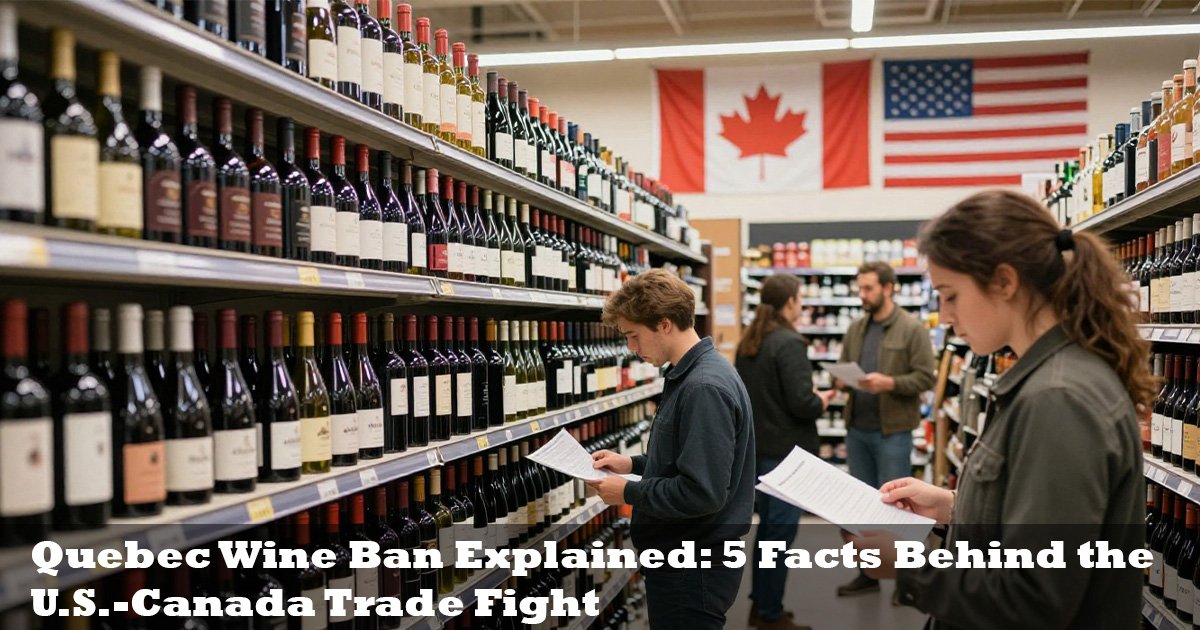
Quebec Wine Ban has become one of the most talked-about trade issues between Canada and the United States. What started as a response to American tariffs has evolved into a prolonged political and economic dispute that is affecting wineries, retailers, restaurants, and consumers on both sides of the border.
California wineries have lost access to one of their most valuable export markets, while Quebec officials remain firm that the restrictions will stay in place until the United States removes tariffs on Canadian goods. The dispute has left store shelves empty of American wines and forced restaurants to rethink their wine lists.
Although wine is at the center of the story, this conflict is about much more than bottles on store shelves. It highlights how trade disagreements can quickly spill into everyday consumer markets and reshape long-standing business relationships.
In this article, we’ll explore why the Quebec Wine Ban began, who is being affected, and what could happen in the months ahead.
What Is the Quebec Wine Ban?
The Quebec Wine Ban refers to the provincial government’s decision to stop purchasing and selling American wines through the Société des alcools du Québec (SAQ), the province’s government-controlled alcohol retailer.
Because the SAQ controls most alcohol distribution in Quebec, the decision effectively removed U.S. wines from retail shelves across the province.
The measure was introduced as part of Canada’s broader response to tariffs imposed by the United States on Canadian steel and aluminum imports. Provincial leaders argued that economic retaliation was necessary to defend Canadian industries.
Unlike a nationwide prohibition, the restriction is administered at the provincial level. This explains why different provinces have taken different approaches, with some later restoring American alcohol products while Quebec has continued enforcing the policy.
For consumers, the change has been immediately visible. Entire sections once filled with Napa Valley Cabernet Sauvignon, Sonoma Pinot Noir, and Washington State wines have disappeared from many stores.
Restaurants have also had to redesign their wine menus, replacing familiar American labels with selections from British Columbia, Ontario, Europe, South America, and Australia.
Why Quebec Introduced the Wine Ban
The origins of the Quebec Wine Ban lie in escalating trade tensions between Canada and the United States.
When Washington introduced tariffs on Canadian steel and aluminum, Canadian governments searched for industries where they could respond effectively.
Alcohol became an obvious target.
Since provincial liquor boards control alcohol purchasing, provinces could quickly remove American products without introducing entirely new legislation.
Quebec’s government made its position clear: the restrictions would remain until the United States removed what it considers unjustified tariffs.
Political tensions added another layer to the dispute. Statements from U.S. political leaders regarding Canada further strengthened public support within Quebec for maintaining the restrictions.
As a result, the wine ban became more than an economic measure—it also became a symbol of political resistance.
Provincial officials have repeatedly emphasized that the decision is tied directly to U.S. trade policy rather than the American wine industry itself.
California’s Wine Industry Pushes Back
Few industries have felt the consequences of the Quebec Wine Ban more than California’s wine producers.
California accounts for roughly 80% of U.S. wine production and has spent decades building relationships with Canadian distributors, restaurants, and consumers.
Those partnerships were disrupted almost overnight.
Industry representatives estimate that California wineries lost access to a market valued at approximately $434 million, making Canada one of the industry’s most significant export destinations.
Large wineries may have enough international distribution to absorb part of the financial impact.
Smaller family-owned vineyards, however, often depend heavily on export markets to maintain stable revenue.
Many producers now face difficult decisions regarding inventory, production planning, and international expansion.
Recognizing the seriousness of the situation, a bipartisan group of California lawmakers appealed directly to Quebec officials, urging them to reconsider the restrictions.
Their message was simple: California wineries should not become casualties of a broader political disagreement between governments.
Despite these diplomatic efforts, Quebec has maintained its position that any changes depend on U.S. trade policy rather than provincial negotiations.
For now, California’s wine industry continues searching for alternative export markets while hoping trade relations improve.
The Growing Impact on the U.S.-Canada Alcohol Trade
The Quebec Wine Ban has affected much more than wine.
American spirits, bourbon, craft beer, and other alcoholic beverages have also experienced declining sales across parts of Canada.
Industry organizations report significant reductions in exports following provincial purchasing restrictions.
For Canadian businesses, the effects are mixed.
Importers specializing in American products have lost important inventory.
At the same time, Canadian wineries and domestic producers have gained greater visibility on store shelves.
British Columbia’s Okanagan Valley wineries, Ontario vineyards, and several international producers have benefited from increased consumer attention.
Restaurants have adapted by introducing customers to local wines that may have previously received less exposure.
Many sommeliers now recommend Canadian alternatives instead of American labels, helping domestic wineries strengthen their market presence.
This shift demonstrates how trade disputes can unexpectedly create opportunities for local industries while challenging international competitors.